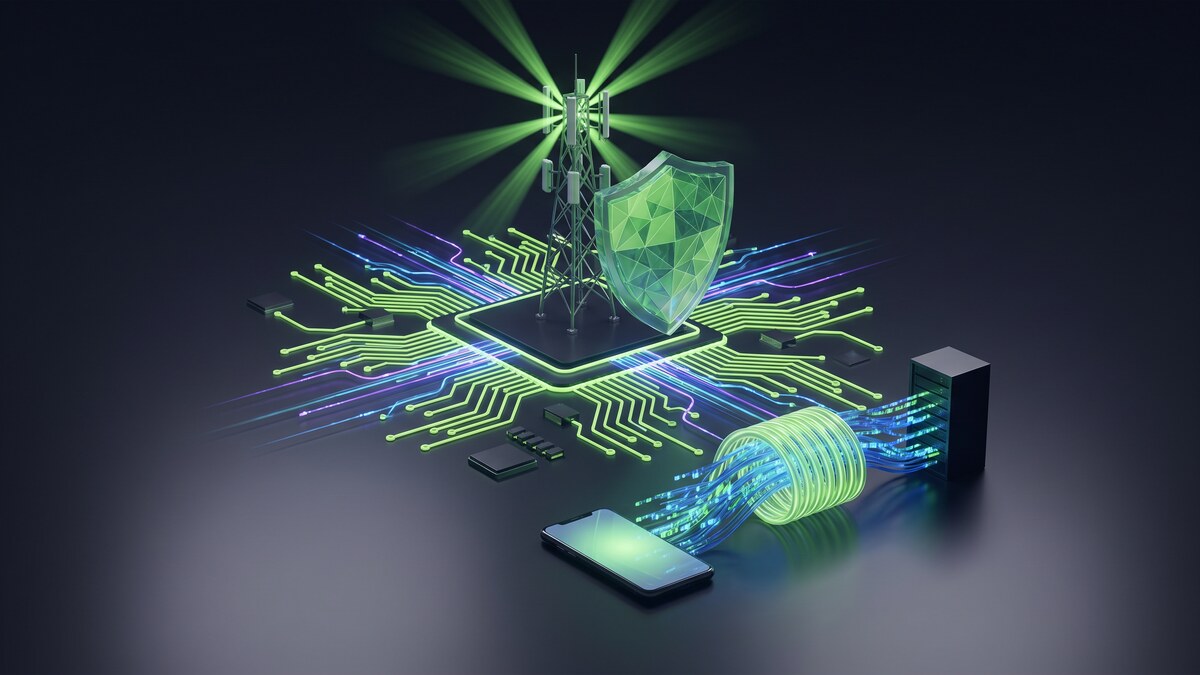
5G is faster, more reliable, and has better built-in encryption than older cellular networks. This leads many people to a reasonable question: if 5G already encrypts your connection, do you still need a VPN?
The answer is yes — and understanding why requires understanding exactly where 5G's security begins and ends, and what your mobile carrier still sees even when you are on a 5G connection.
How 5G Security Actually Works
5G does encrypt your traffic between your phone and the cell tower. This is a genuine improvement over older cellular generations. The encryption happens at the radio layer — it protects your data from being intercepted by someone in the immediate physical vicinity of the tower, which eliminates one category of attack that was possible with older 3G and 4G connections.
But the encryption is only between your device and the carrier's infrastructure. Once your traffic reaches the carrier's network, it is decrypted. The carrier can see everything you do: which websites you visit, which domains your apps connect to, how much data you transfer, and when. This is not a flaw or an oversight — it is how cellular networks are designed to operate.
According to Tom's Guide's 2026 analysis of 5G vs. public Wi-Fi security, while 5G avoids many of the local snooping risks of shared Wi-Fi networks, it does not make your activity private from your carrier. Your mobile carrier knows where you are (through cell tower triangulation), which domains your device requests, and how your data usage patterns over time — information routinely used for network management and, in many cases, advertising.
In the United States, mobile carriers are permitted to collect and sell this data in the same way that fixed-line ISPs can. A VPN encrypts your traffic before it reaches the cellular network, removing your carrier's visibility into your browsing destinations entirely.
5G vs. Public Wi-Fi: A Genuine Security Improvement
Before explaining what a VPN adds to 5G, it is worth acknowledging what 5G genuinely improves over public Wi-Fi:
- No shared local network. On public Wi-Fi, every user on the same network can potentially intercept traffic from other users. On 5G, there is no shared local network — each device has a direct encrypted connection to the tower. Man-in-the-middle attacks that work on open Wi-Fi are not possible on 5G in the same way.
- No evil twin hotspots. On Wi-Fi, attackers can create fake hotspots with convincing names and capture all traffic from anyone who connects. With 5G, you connect to authenticated cellular infrastructure — not an arbitrary access point controlled by a stranger.
- Tower-level encryption by default. You do not need to configure anything. Every 5G connection is encrypted at the radio layer without any user action.
For quick, sensitive tasks — checking a bank balance, using a work tool briefly, sending an important message — 5G is meaningfully safer than connecting to random public Wi-Fi. Tom's Guide's comparison recommends 5G over public Wi-Fi for exactly these short, sensitive sessions.
But this comparison is between 5G and unprotected public Wi-Fi. The relevant comparison for most VPN users is: 5G alone vs. 5G with a VPN.
What Your Carrier Still Sees on 5G
Even on a 5G connection, without a VPN your mobile carrier can see:
- Every domain you visit. DNS queries — the lookups that convert domain names like example.com into IP addresses — typically go through your carrier's DNS servers. Your carrier logs every domain your device requests, even when your traffic is encrypted over HTTPS.
- Your IP address and the IP addresses you connect to. Your carrier can see the source and destination of every connection your phone makes, even if they cannot read the content.
- Your physical location. Cell tower triangulation gives your carrier an accurate, continuous record of where you are. This is inherent to how cellular networks function and cannot be changed by any VPN.
- Timing and volume of traffic. When you connected to what, how much data transferred, which services you use — all visible at the carrier level even without reading content.
- Unencrypted traffic. Any app or service that still uses HTTP (not HTTPS) sends its content in plaintext through your carrier's infrastructure.
A VPN encrypts your traffic before it reaches the cellular network. Your carrier sees an encrypted connection to a VPN server — nothing about which sites you visit, which apps connect where, or what content flows through the connection. Your DNS queries route through the VPN's encrypted resolvers rather than your carrier's servers, removing domain-level visibility entirely.
What 5G Cannot Hide From Your Carrier — A VPN Can
CyberFence encrypts your entire connection before it reaches any network — cellular or Wi-Fi — and routes DNS through our own encrypted resolvers. Your carrier sees nothing but an encrypted tunnel. Starting at $7.99/month.
Start Free Trial5G Security Vulnerabilities That Persist
5G is more secure than its predecessors, but it is not without its own vulnerabilities. NordVPN's security analysis identifies several that remain relevant:
Inherited Legacy Vulnerabilities
5G does not replace 4G and 3G — it coexists with them. In many situations, your device falls back to 4G or even 3G when 5G coverage is unavailable. Calls and some data transfer still route through older protocols. Security flaws in 3G and 4G message exchange protocols persist in 5G environments precisely because the networks must remain compatible. An attacker targeting a device that briefly falls back to 4G can exploit vulnerabilities that 5G was supposed to eliminate.
Software-Defined Network Attack Surface
5G has shifted from hardware-based to software-defined infrastructure. This makes the network more flexible and easier to update — but it also means that security flaws in software code become 5G security vulnerabilities. Software vulnerabilities are more common than hardware failures, and the expanded software surface of 5G infrastructure is a new attack plane that did not exist in earlier generations.
Vendor Dependency Risks
5G infrastructure is built by a small number of vendors globally. Concerns about vendor backdoors in 5G infrastructure — which led to US restrictions on certain foreign-manufactured equipment — reflect a real risk: infrastructure vendors could, deliberately or through compromise, introduce surveillance capabilities into the network stack. A VPN encrypts your traffic before it reaches that infrastructure, providing a layer of protection against infrastructure-level surveillance regardless of who built the towers.
Stingray / IMSI Catcher Attacks
Law enforcement and other actors use IMSI catchers (sometimes called stingrays) — devices that impersonate cell towers to intercept mobile traffic. While 5G has improved protections against some IMSI catcher attacks compared to 4G, the protection is not complete. A VPN does not prevent IMSI catcher interception of the radio-layer connection, but it ensures that even if the connection is intercepted at the radio layer, the traffic is encrypted and unreadable.
When 5G Alone Is Sufficient
There are situations where using 5G without a VPN is an acceptable trade-off:
- Quick, low-sensitivity tasks: Checking the weather, looking up a map direction, streaming music — activities where you are not transmitting credentials or sensitive data and do not particularly care whether your carrier sees the domain.
- Emergency situations: When you need fast connectivity immediately and turning on a VPN would cause meaningful delay. A VPN adds minimal latency in normal use, but in a genuine emergency, the priority is connectivity.
- Activities where carrier visibility is not a concern: If you are comfortable with your carrier knowing which streaming service you use and at what time, and the content is not sensitive, 5G without a VPN is adequate for that specific use case.
When You Still Need a VPN on 5G
Use a VPN on 5G for:
- Any sensitive login credentials: Banking, work platforms, healthcare portals, payment apps — anything where the credentials themselves have value. A VPN encrypts those credentials end-to-end, so even if carrier-level traffic is observed, the content is unreadable.
- Privacy from your carrier: If you do not want your mobile carrier logging your domain-level browsing history — which they are permitted to sell in the US — a VPN removes their visibility entirely.
- Work-related activity on any network: Accessing company systems, client data, or anything under contractual security obligations requires encryption that goes beyond what your carrier provides.
- Any activity where your ISP's privacy policy matters: As explained in our guide on what your ISP can see with a VPN, a VPN is the only tool that prevents carrier-level data collection on your browsing activity.
- International travel: Mobile roaming abroad may route through foreign carrier infrastructure with different data handling practices. A VPN provides consistent protection regardless of which carrier's network your device roams onto.
Does a VPN Slow Down 5G?
This is a practical concern worth addressing directly. 5G is fast — peak speeds well above 1 Gbps in optimal conditions. VPN encryption adds computational overhead. Does that overhead matter on a 5G connection?
In practice, the answer for most users is no. Modern VPN protocols like WireGuard are highly efficient. The overhead introduced by AES-256-GCM encryption on modern hardware is minimal — typically less than 10-15% latency increase for standard web browsing and app usage. For activities that fully utilize 5G's peak throughput (downloading very large files at multi-Gbps speeds), there may be a more noticeable impact. For everyday use — browsing, email, video calls, app connectivity — the difference is not perceptible.
For a full breakdown of how VPN speed works, see our guide on does a VPN slow down your internet.
Works on Every Network — Including 5G
CyberFence's AES-256-GCM encryption adds minimal latency on any connection, cellular or Wi-Fi, and protects your traffic from your carrier's visibility on every 5G session. Zero logs, kill switch, Web Shield. Starting at $7.99/month.
View PlansThe Bottom Line
5G is a genuine security improvement over public Wi-Fi and over older cellular generations. The radio-layer encryption, absence of a shared local network, and protection against casual eavesdropping are real advantages.
But 5G does not make a VPN unnecessary. Your carrier still sees every domain you visit, your physical location, and your traffic patterns. The radio-layer encryption does not persist past your carrier's infrastructure. And the 5G network inherits some legacy vulnerabilities from older protocols it must remain compatible with.
A VPN adds what 5G cannot provide: end-to-end encryption that persists all the way to the destination, DNS privacy from your carrier, and protection against carrier-level data collection. On 5G, as on Wi-Fi, a VPN remains the most effective tool for keeping your browsing activity private from everyone between your device and the websites you visit.
Start CyberFence's Free Trial — it works on 5G, Wi-Fi, and every connection type your devices use, with no configuration changes needed between networks.