Also on CyberFence: CyberFence's industry directory for other professions · CyberFence for Teams for business VPN with BAA and SSO .
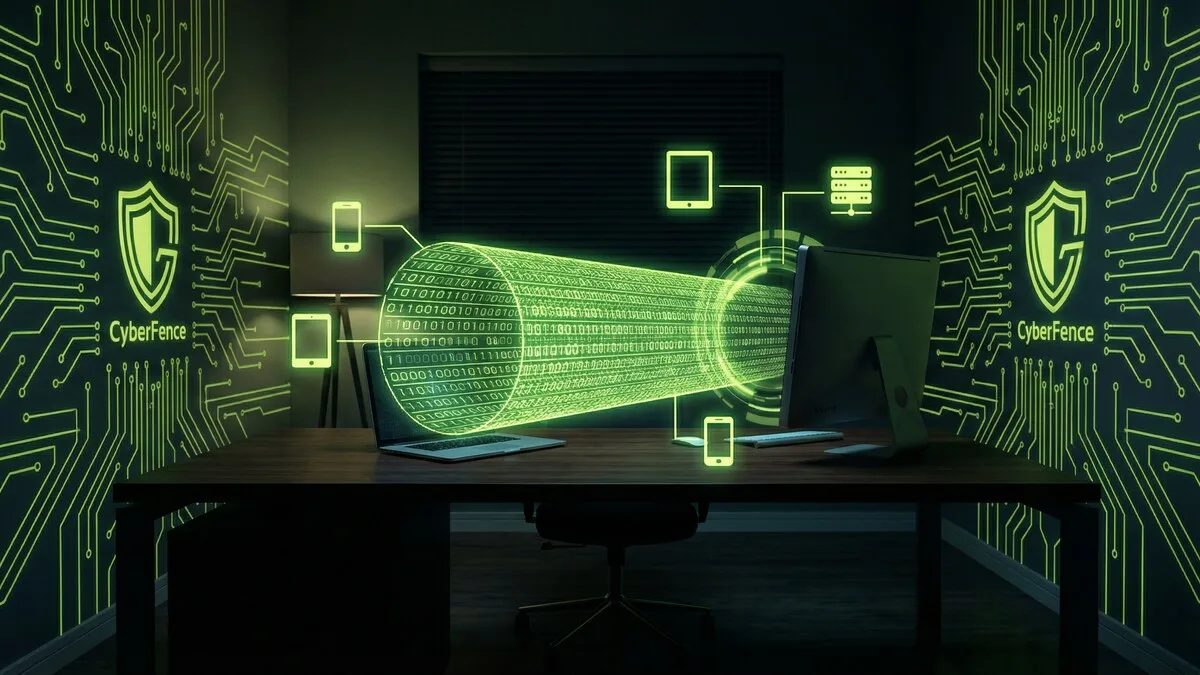
Remote work is the new normal. And with it came a massive, mostly invisible security problem: company data is now flowing across home networks, coffee shop Wi-Fi, hotel connections, and every other network your employees happen to be near.
Without protection, that data is exposed — to hackers, to ISPs, and to anyone else monitoring the network.
Cyber attacks increased dramatically after the pandemic-era shift to remote work. Phishing, man-in-the-middle attacks, and ransomware incidents all spiked as employees moved off protected corporate networks onto home and public connections.
The Remote Work Security Problem
When your employees work from the office, they're protected by your corporate firewall, network monitoring, and IT infrastructure. The moment they go remote, all of that disappears. Their traffic flows through:
- Home routers with default passwords and outdated firmware
- Coffee shop and hotel Wi-Fi shared with strangers
- Mobile hotspots with no additional security
- ISPs that log, analyze, and sometimes sell browsing data
For businesses handling sensitive data — client records, financial information, health records — this isn't just a security concern. It's a compliance issue.
What a VPN Does for Remote Workers
A VPN creates an encrypted tunnel between your employee's device and a secure server. Everything sent through that tunnel is encrypted — completely unreadable to anyone who intercepts it.
For remote workers, this means:
- Secure access from any network — coffee shop, hotel, home, or airport
- Company data stays encrypted while in transit
- Employee browsing stays private from ISPs and network operators
- Protection from malware and phishing (with CyberFence's Web Shield)
- Compliance support for regulated industries
What to Look For in a Remote Work VPN
1. Business/Teams Support
Consumer VPNs aren't built for business use. Look for a VPN that supports centralized management, unlimited device coverage, and dedicated support for your organization.
2. US-Based Infrastructure
For businesses operating in the US, routing traffic through US-based servers means faster speeds and the legal protections of US law — not foreign jurisdictions with less favorable privacy laws.
3. Compliance Coverage
If your business operates under HIPAA, SEC, NIST, or CMMC requirements, your VPN needs to support those frameworks. Many generic VPNs don't. CyberFence is built with compliance in mind.
4. Web Shield / Threat Protection
Encryption alone isn't enough. Remote employees clicking phishing links or downloading malware can still compromise your business even on a VPN. Look for a VPN that actively blocks threats — not just encrypts traffic.
5. Multi-Device Support
Remote workers use laptops, phones, tablets, and home computers. Your VPN needs to cover all of them — seamlessly — under a single account.
The Cost of Not Using a VPN
| Incident Type | Average Cost (US 2025) |
|---|---|
| Data Breach (SMB) | $4.9 million avg |
| Ransomware Attack | $1.5 million avg |
| HIPAA Violation Fine | $100 — $50,000 per violation |
| Business Email Compromise | $137,000 avg per incident |
Compare that to the cost of CyberFence Teams — which protects your entire workforce at a fraction of the cost of a single incident.
CyberFence for Remote Teams
Carlos Perez is the Founder of CyberFence. Before launching CyberFence, he worked at Avanade, Accenture, and Microsoft, keeping enterprises safe. But he saw a clear problem — enterprise-level protection wasn't reaching the people who needed it most. CyberFence was built to close that gap — bringing powerful, enterprise-grade security into a simple, modern platform designed for businesses & everyday users.
With the CyberFence Teams plan, your entire workforce gets:
- Unlimited user accounts and devices
- US-based VPN with AES-256 encryption
- Web Shield — malware and phishing protection for every employee
- Dedicated account manager and one-on-one onboarding
- Compliance documentation for HIPAA, NIST, CMMC, and SEC
- Centralized management and reporting
The Bottom Line
Remote work isn't going away. Neither are the security risks that come with it. A VPN isn't a luxury for remote teams — it's a baseline security requirement.
If your employees are working outside the office without a VPN, your company's data is exposed every time they connect to any network that isn't yours.
Contact us about CyberFence Teams — or start with a personal plan and try it free.
Want to go deeper? Read how CyberFence protects other regulated industries , the CyberFence Teams product page , or CyberFence plans and pricing .