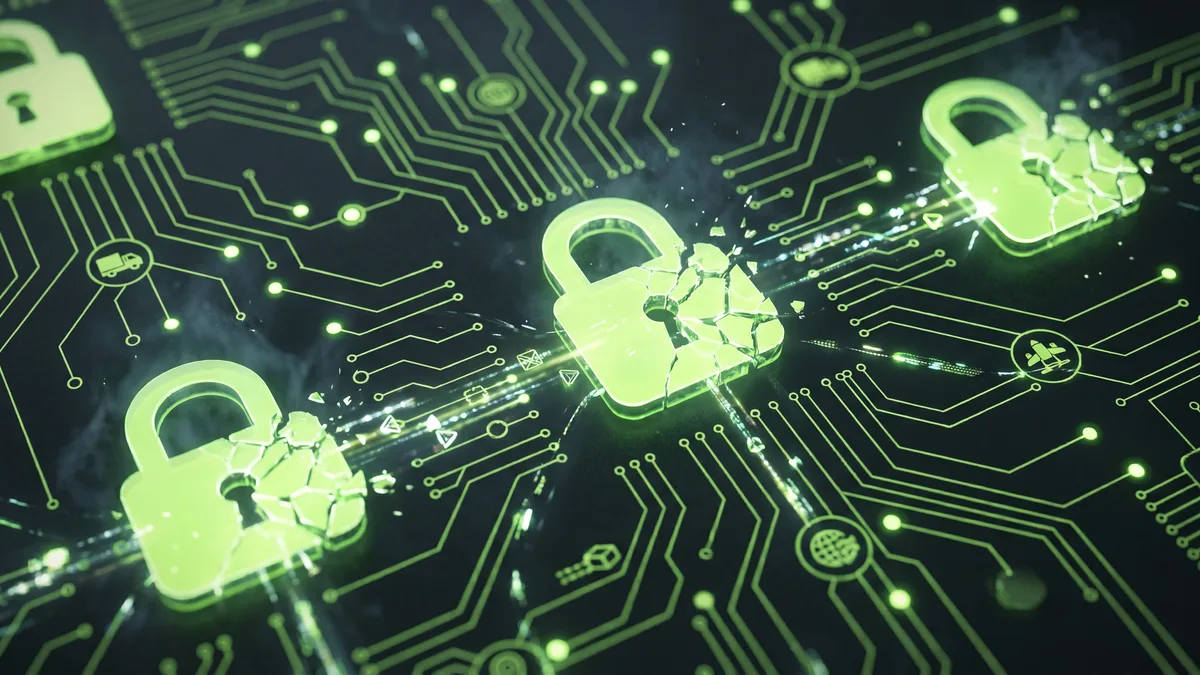
You locked the front door. You installed antivirus software. You trained your staff on phishing emails. And yet, attackers walked right in — through your payroll vendor, your cloud storage provider, or the software tool your team uses every day.
This is the reality of supply chain attacks in 2026. Cybercriminals have discovered that the fastest path into a well-defended organization is through the organizations it trusts. And the numbers are alarming.
According to the Verizon 2026 Data Breach Investigations Report, nearly 30% of all data breaches now involve a third-party supplier — double the rate from just a few years ago. The World Economic Forum's Global Cybersecurity Outlook 2026 found that over half of large organizations now identify supply chain complexity as the single greatest barrier to cyber resilience. And a Cybersecurity Ventures forecast estimates the global annual cost of software supply chain attacks will reach $60 billion in 2025, rising to $138 billion by 2031.
If you run a small business — or work at one — this is not a problem reserved for Fortune 500 companies. In fact, you may be the target.
What Is a Supply Chain Attack?
A supply chain attack occurs when a cybercriminal compromises a third party — a software vendor, cloud service, managed service provider, or hardware manufacturer — to gain access to that vendor's customers. Instead of attacking you directly, attackers attack your suppliers.
The logic is ruthless: why spend months trying to penetrate a hardened corporate network when you can compromise a small software company that serves 10,000 businesses? One successful attack yields 10,000 victims.
This is exactly what happened in the SolarWinds breach. Attackers inserted malicious code into a routine software update, which was then automatically downloaded by approximately 18,000 organizations — including U.S. federal agencies. The MOVEit file transfer attack followed a similar playbook, ultimately affecting more than 2,700 organizations and exposing the data of over 93 million individuals, according to DeepStrike's Supply Chain Attack Statistics 2025.
These weren't brute-force attacks. They were elegant, patient, and devastating — and they bypassed every security control the victims had in place.
The Scale of the Problem in 2025 and 2026
The data paints a stark picture of how rapidly this threat has grown:
- Third-party breaches doubled: The Verizon DBIR 2025 showed that the share of breaches involving a third party surged from 15% to 30% in a single year.
- Software supply chain attacks tripled: Risk Ledger's Top 10 Supply Chain Risks 2026 report notes a threefold increase in software supply chain attacks in the past year alone, with adversaries targeting open-source libraries and critical infrastructure alike.
- Open-source poisoning accelerated: The Sonatype 2024 State of the Software Supply Chain report logged over 512,847 malicious packages in open-source repositories in a single year — a 156% year-over-year increase.
- More than 75% of organizations experienced a software supply chain attack within the past year, according to a BlackBerry survey cited by DeepStrike.
- 267 days: That's the average time it takes to identify and contain a supply chain breach — a full week longer than attacks caused by malicious insiders, per IBM's research.
The financial damage is equally staggering. IBM's Cost of a Data Breach 2025 report puts the global average data breach cost at $4.44 million. For U.S. companies, that figure reaches a record $10.22 million. When the breach originates from a third-party system, the average remediation cost climbs even higher — FortifyData reports it at nearly $4.8 million, exceeding costs for internally caused breaches.
Is your business exposed through its vendors? CyberFence's DNS-layer threat filtering blocks malicious domains — including those used in supply chain malware campaigns — before they can reach your devices. Explore CyberFence plans →
Why Small Businesses Are Prime Targets
There's a damaging myth in cybersecurity: that small businesses are too small to bother with. Attackers have proven the opposite. Small and mid-sized businesses are not the end target — they're the entry point.
As DeepStrike's analysis makes clear, it is often far more effective for an attacker to compromise a small vendor with weak security than to launch a direct assault against a Fortune 500 company. Large enterprises have dedicated security teams, enterprise firewalls, and sophisticated monitoring. Small vendors serving those enterprises often do not.
The World Economic Forum identifies this asymmetry as a primary driver of what it calls "cyber inequity" — the growing security maturity gap between large organizations and the smaller suppliers they depend on. Small businesses sit squarely at the vulnerable end of this gap.
Additionally, a Splunk analysis notes that 62% of organizations reported supply chain disruption due to cybersecurity issues. Supply chain attacks are now the most common cyberattack method in the retail sector at 52%, ahead of data breaches and phishing, according to VikingCloud's 2026 Cybersecurity Statistics.
The Most Dangerous Supply Chain Attack Vectors
Understanding how these attacks unfold is the first step toward defending against them. According to the Risk Ledger and WEF reports, the most dangerous vectors in 2026 include:
1. Software Updates and CI/CD Pipeline Poisoning
Attackers infiltrate a vendor's build environment, inject malicious code, and let the vendor's own update mechanism deliver the payload to thousands of customers. The SolarWinds and 3CX incidents are textbook examples. CI/CD pipelines — the automated systems developers use to build and deploy software — are prime targets.
2. Open-Source Library Compromise
Modern applications depend on hundreds of open-source components. When an attacker poisons one widely-used library, every application that imports it becomes infected. The explosion of malicious packages — over 704,000 logged since 2019 — makes this one of the fastest-growing threats in software security.
3. Managed Service Provider (MSP) Exploitation
Small businesses frequently rely on MSPs for IT support, cloud management, and security monitoring. If an MSP is compromised, every client they serve is exposed. The Kaseya VSA attack in 2021 demonstrated this at scale, with ransomware spreading to over 1,500 businesses through a single MSP platform.
4. Shadow IT and Unvetted SaaS Tools
Employees routinely adopt new SaaS tools — project management apps, file sharing services, communication platforms — without formal security review. Each unvetted application creates an invisible connection to an external vendor whose security posture is unknown. Risk Ledger identifies this as one of the most overlooked supply chain risks in 2026.
5. Physical Hardware Tampering
Hardware supply chains are not immune. Investigations have uncovered backdoors in manufactured hardware and implants in supply chains serving both commercial and government targets. The Risk Ledger report cites real-world examples from recent years that would have been dismissed as fiction a decade ago.
What Small Businesses Can Do Right Now
The good news is that supply chain attacks, while sophisticated, are not unstoppable. A layered security approach — applied consistently — dramatically reduces your exposure. Here's where to start:
Audit Your Vendor Relationships
Make a complete list of every software tool, cloud service, and third-party vendor your business uses. For each, ask: What data can they access? Do they have access to your network? What happens if they are breached? You cannot protect what you haven't mapped.
Apply the Principle of Least Privilege
Every vendor, application, and employee should have access only to what they absolutely need — nothing more. Limit the blast radius of any third-party compromise by ensuring attackers who get in through a vendor can't roam freely across your systems.
Require Security Certifications from Vendors
Before onboarding a new vendor, ask about their security practices. Do they hold ISO 27001 certification? Have they completed a SOC 2 audit? Do they have a process for notifying customers of breaches? Vendors who can't answer these questions are a liability.
Enable DNS-Layer Threat Filtering
Many supply chain attacks rely on malware that calls back to attacker-controlled domains — for command and control, data exfiltration, or ransomware staging. DNS filtering blocks these malicious domains at the network level, before a connection is ever established. This is one of the most effective ways to stop supply chain malware in its tracks, even when your endpoint security misses it.
Use a VPN with Integrated Threat Protection
When your employees connect through a secure VPN with built-in threat monitoring, you gain visibility into the traffic flowing between your team's devices and the internet — including traffic to and from third-party applications. Encrypted tunneling also prevents attackers who have compromised your network from intercepting data in transit.
CyberFence combines VPN encryption with DNS-level threat filtering and breach monitoring — giving small businesses enterprise-grade supply chain defenses without the enterprise price tag. See pricing and get started →
Monitor for Breach Exposure
Even with strong defenses, credentials from your vendors or your own team may surface in data breaches. Continuous breach monitoring alerts you the moment your email addresses or passwords appear in a leaked dataset — giving you time to act before attackers can exploit them. Learn more about how breach monitoring works and why it matters for supply chain defense.
Keep Software and Firmware Updated
Updates patch known vulnerabilities that supply chain attackers exploit. The Verizon 2026 DBIR confirms that exploitation of software vulnerabilities has overtaken stolen passwords as the top initial access method in breaches. Delays in patching are delays in closing the doors attackers walk through.
The Regulatory Pressure Is Growing
Governments are responding to the supply chain threat with new requirements. The SEC now requires publicly traded companies to report material cybersecurity incidents within four business days. The White House's Executive Order on improving U.S. cybersecurity mandates software supply chain security practices including Software Bills of Materials (SBOMs) for federal vendors. The EU's NIS2 Directive, which took effect in 2024, extends cybersecurity obligations explicitly to supply chains.
While many of these regulations initially target larger organizations, enforcement trends consistently trickle down to smaller businesses over time — particularly those that serve regulated industries like healthcare, finance, and government. If your clients operate in these sectors, their regulatory requirements will eventually become yours.
For a broader look at how privacy regulations are reshaping business obligations, see our guide to state privacy laws and VPN requirements in 2026.
The Bottom Line: Your Vendors Are Your Attack Surface
In 2026, cybersecurity is no longer just about protecting your own systems — it's about understanding the security posture of every organization connected to yours. Supply chain attacks have tripled. Third-party breaches have doubled. The global cost of these attacks is climbing toward $60 billion annually.
Small businesses are not too small to be targeted. They are often the preferred entry point. But they are not powerless.
A combination of vendor auditing, least-privilege access controls, DNS-layer threat filtering, encrypted VPN connections, and continuous breach monitoring creates a defense-in-depth posture that makes supply chain attacks significantly harder to execute. These are not theoretical future capabilities — they are available today, at a price point accessible to any business.
The question is not whether your vendor will be targeted. The question is whether you'll be protected when they are.
CyberFence brings together the tools small businesses need to defend against supply chain threats: DNS filtering that blocks malicious callbacks, encrypted network protection, and breach monitoring that watches for your credentials in the dark. Start protecting your business today.