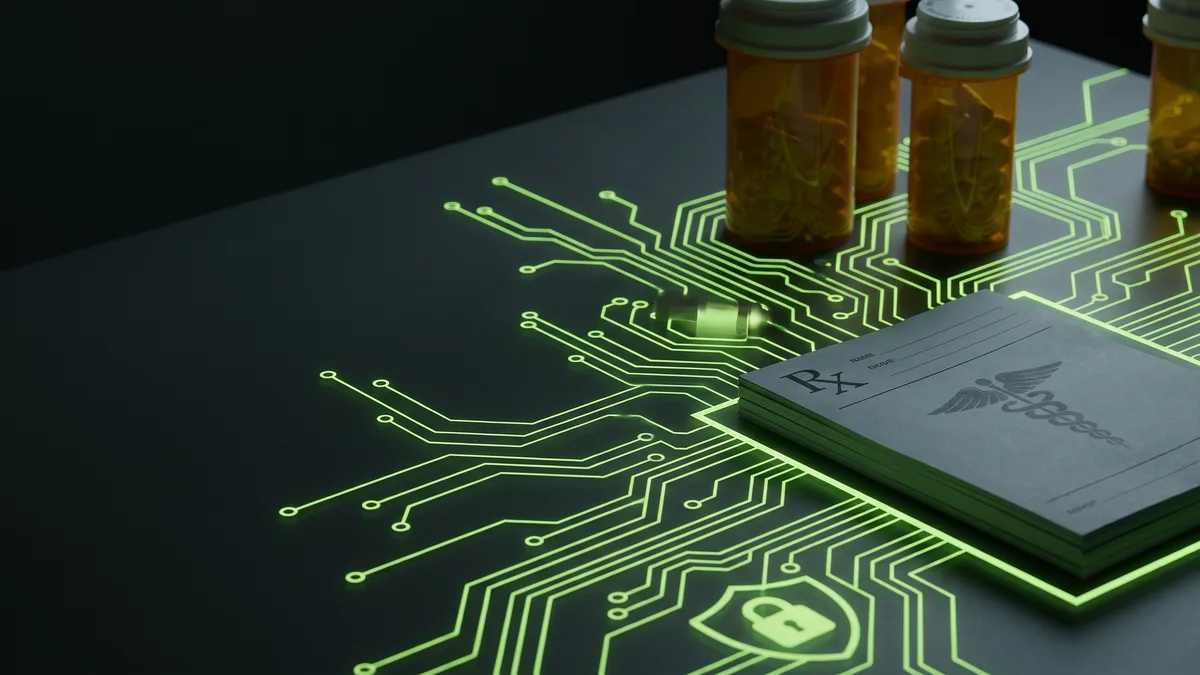
Pharmacists sit at a uniquely dangerous intersection of healthcare and technology. Every prescription filled, every insurance claim submitted, every patient counseling session conducted over a remote connection involves Protected Health Information (PHI) — the most valuable data type on the internet. A single stolen medical record now sells for $260–$310 on the dark web, roughly ten times the value of a stolen credit card.
If your pharmacy team uses email, remote dispensing software, telehealth platforms, or cloud-based pharmacy management systems — without a VPN — that PHI is traveling across the internet in a form that can be intercepted, logged, and sold. This guide explains exactly what a VPN does for pharmacists and pharmacy teams, why HIPAA demands it, and how to choose the right solution.
CyberFence encrypts all pharmacy network traffic with AES-256-GCM, blocks phishing domains, and includes a no-logs policy — built for HIPAA-regulated environments.
Start Your Free Trial — Plans from $7.99/mo →Why Pharmacies Are Prime Cyberattack Targets
Pharmacies are not incidental targets — they are primary ones. The combination of financial data (insurance billing), personal identifying information (Social Security numbers, dates of birth), and sensitive medical data (diagnoses, medication history) makes pharmacy databases extraordinarily lucrative.
The numbers paint a stark picture. In 2024 alone, 276 million patient records were compromised in healthcare breaches — representing 81% of the U.S. population, according to HHS OCR data. The average healthcare breach now costs $9.8 million per incident, more than double the financial sector and the highest average of any industry for 14 consecutive years.
Pharmacies specifically have faced high-profile attacks. In 2023, PharMerica — which operates more than 180 long-term care and specialty pharmacies across all 50 states — disclosed a ransomware breach exposing data on nearly 6 million customers, including Social Security numbers, medication lists, and health insurance details. The Money Message ransomware gang claimed responsibility.
Earlier data from the HIPAA Journal showed that phishing attacks targeting pharmacies and hospitals surged 189% in just a two-month window. These are not isolated events — they represent a sustained, escalating campaign against pharmacy infrastructure.
What HIPAA Actually Requires From Pharmacies
Under HIPAA's Security Rule, pharmacies classified as Covered Entities must implement specific technical safeguards for electronic PHI (ePHI). The regulation requires:
- Access controls — only authorized users can access PHI systems
- Transmission security — ePHI must be encrypted when transmitted over open networks
- Audit controls — systems must log who accessed what data and when
- Integrity controls — data must be protected from improper alteration or destruction
The penalties for non-compliance are severe. HIPAA fines are tiered from $100 to over $2 million per violation category per year. Historical pharmacy enforcement actions include CVS Pharmacy's $2.25 million settlement in 2009, Rite Aid's $1 million settlement in 2010, and Walgreens' $1.4 million fine in 2014. More recently, the 2025 enforcement cycle saw multiple settlements ranging from $182,000 to $1.5 million across the healthcare sector.
A VPN directly addresses the transmission security requirement by encrypting all data in transit between a pharmacist's device and the systems they're accessing.
The Specific Risks Facing Pharmacy Teams
Remote Dispensing and Telepharmacy
Telepharmacy has expanded dramatically — pharmacists now verify prescriptions, counsel patients, and supervise dispensing via remote connections across rural hospitals, long-term care facilities, and retail chains. Every one of those sessions transmits PHI. If a telepharmacist connects from home over their residential ISP or a coffee shop hotspot without a VPN, their ISP can log the traffic, and any interceptor on the network can read unencrypted data.
Pharmacy Management Software Access
Platforms like QS/1, PioneerRx, and Liberty Software are accessed remotely by pharmacists working from home or traveling between locations. Without a VPN tunnel, credentials and session data can be intercepted on unsecured networks — giving attackers authenticated access to patient records.
Insurance and PBM Portals
Pharmacy benefit manager (PBM) portals handle insurance claims that contain diagnoses, drug codes, and patient identifiers. These portals are frequently targeted by credential-stuffing attacks. A VPN adds a layer of protection by masking the pharmacy team member's true location and encrypting the connection, making credential harvesting significantly harder.
Public and Hotel Wi-Fi During Travel
Traveling pharmacists — whether attending conferences, visiting multiple pharmacy locations, or conducting clinical outreach — often rely on hotel or airport Wi-Fi. These networks are notoriously insecure. Without a VPN, any PHI accessed on these networks is exposed to anyone on the same network running a packet sniffer.
How a VPN Protects Pharmacy Operations
A quality VPN creates an encrypted tunnel between the pharmacist's device and the internet, so all data — including PHI — passes through AES-256-GCM encryption before leaving the device. Here's how that maps to pharmacy workflows:
- Encrypted prescription verification — telepharmacy sessions are shielded from interception
- Secure PBM and insurance portal access — credentials and claims data are protected on any network
- Safe home office connectivity — remote pharmacists meet HIPAA transmission security requirements
- DNS filtering — blocks malicious pharmacy-spoofing domains used in phishing campaigns targeting pharmacy staff
- Kill switch — automatically cuts internet access if the VPN drops, preventing accidental PHI exposure on unsecured connections
CyberFence for Pharmacy Teams: Built for Healthcare Compliance
CyberFence is purpose-built for professionals in HIPAA-regulated environments. Unlike generic consumer VPNs that prioritize streaming speed over security architecture, CyberFence delivers features that match pharmacy compliance requirements:
- AES-256-GCM encryption on all connections — the current gold standard for PHI transmission
- Strict no-logs policy — CyberFence does not store connection logs, metadata, or browsing history, meaning there is no internal database of PHI access patterns to breach
- DNS-level phishing protection — blocks malicious domains before they load, addressing the 189% surge in pharmacy-targeted phishing attacks
- Automatic kill switch — prevents data exposure if the VPN connection drops unexpectedly
- Multi-device support — covers desktops, laptops, tablets, and mobile devices used by the full pharmacy team
- US-based infrastructure — data never transits foreign servers, supporting domestic compliance requirements
For independent pharmacies and small pharmacy chains, CyberFence's team plans start at $7.99/month per user — a fraction of the cost of a single HIPAA violation penalty.
Cover your entire team — pharmacists, technicians, and administrative staff — with encrypted, no-logs VPN protection. CyberFence meets HIPAA transmission security requirements out of the box.
See Pharmacy Team Plans and Pricing →Setting Up VPN for Your Pharmacy Team: Practical Guidance
Step 1: Identify All PHI Access Points
Map every location where pharmacy staff access ePHI: the dispensing workstation, remote login terminals, home office setups, mobile devices used for patient counseling. Every one of these is a mandatory VPN deployment point under HIPAA's transmission security rule.
Step 2: Deploy on All Devices
A VPN is only effective when it's running. Install CyberFence on every device that touches PHI — including the pharmacy manager's personal laptop used for after-hours administrative work and any tablets used for telepharmacy consultations. Enable auto-connect so the VPN activates every time a device joins any network.
Step 3: Enable Always-On VPN Policies
For pharmacy teams, always-on VPN is not optional — it's a compliance requirement. Configure CyberFence's kill switch so that if the VPN drops, all internet traffic is blocked until the secure tunnel is restored. This prevents accidental PHI transmission on open networks.
Step 4: Document It for Your HIPAA Risk Assessment
HIPAA requires covered entities to conduct and document risk assessments. Your VPN deployment should be recorded as a technical safeguard in your Security Rule compliance documentation. CyberFence's no-logs policy also supports your audit controls obligations — there is no internal log database that could itself become a breach source.
Step 5: Train Your Staff
Technology without training creates a false sense of security. Ensure all pharmacy team members understand why the VPN must be active when accessing any PHI system — including from home. Document this training as part of your HIPAA compliance program.
What Happens Without a VPN
The consequences of operating without a VPN in a pharmacy environment are not hypothetical. A pharmacist accessing a PBM portal from a hotel's unsecured Wi-Fi — without a VPN — exposes their session cookies and credentials to any other guest running a network analysis tool. That access can be used to harvest patient records, submit fraudulent claims, or exfiltrate a database for dark web sale.
HIPAA's Breach Notification Rule then kicks in: the pharmacy must notify affected individuals, the HHS Office for Civil Rights, and potentially the media (for breaches affecting more than 500 residents of a state). The average breach lifecycle in healthcare is 213 days — seven months during which the attacker has unfettered access before detection.
The reputational damage to a local pharmacy — where patient trust is the core business asset — can be irreversible. Patients who learn their prescription histories were exposed do not return.
VPN vs. Other Security Measures: What Pharmacies Still Need
A VPN is not a complete cybersecurity program, but it addresses the transmission security gap that HIPAA explicitly requires to be filled. Pharmacies should layer VPN protection alongside:
- Multi-factor authentication on all PHI systems
- Endpoint encryption on all devices storing ePHI
- Regular staff security training — phishing awareness in particular
- Business Associate Agreements (BAAs) with all software vendors who handle PHI
- Regular HIPAA risk assessments documented and updated annually
CyberFence's built-in phishing protection and DNS filtering add additional layers beyond basic VPN encryption, making it a particularly strong fit for pharmacy environments where phishing is the leading attack vector. For a broader overview of HIPAA compliance requirements, the HIPAA-compliant VPN guide covers the full regulatory framework.
The Bottom Line for Pharmacists
Your pharmacy holds some of the most sensitive data in existence: what medications patients take, what conditions they have, their insurance information, their Social Security numbers. That data is worth more than credit cards on the criminal market. HIPAA mandates you protect it in transit. And the enforcement record shows regulators are actively pursuing violations.
A VPN is not a luxury for pharmacy teams — it is a foundational compliance control. CyberFence makes deployment straightforward, affordable, and built around the no-logs, high-encryption architecture that HIPAA-regulated environments require.
For $7.99/month — or $88.21/year on the annual plan — every pharmacist, technician, and pharmacy manager on your team can work from any location knowing that every byte of patient data they transmit is shielded by AES-256-GCM encryption. That is a small price relative to the $9.8 million average cost of a healthcare breach.