Construction might be the last industry you'd expect cybercriminals to target. No hospitals. No banks. Just blueprints, subcontractors, and concrete. But that perception is exactly why hackers love it.
Construction is now the third most targeted industry for ransomware attacks, according to SecurityHQ's 2024 Threat Intelligence Report. The Akira and Black Basta ransomware groups have been specifically naming construction firms as primary targets — and for good reason. Your company handles large wire transfers, sensitive bid documents, client PII, and proprietary project specs. Field workers jump between public WiFi networks all day. Subcontractors log into your systems from unsecured connections. It's a perfect storm for a breach.
A VPN (Virtual Private Network) won't solve every cybersecurity problem — but it closes some of the most dangerous gaps construction companies face daily. Here's what you need to know.
Why Construction Companies Are High-Value Targets
Hackers don't just go after hospitals and banks anymore. They go after money — and construction moves a lot of it.
The average breach in the industrial sector (which includes construction) cost organizations $830,000 more per breach in 2024 than the prior year, according to IBM's Cost of a Data Breach report. Here's what makes construction so attractive to attackers:
- Wire transfer fraud: Construction projects involve large milestone payments. A single fraudulent wire transfer — triggered by a compromised email or spoofed vendor — can wipe out a project's entire profit margin.
- Bid data theft: Your competitors (or their allies) would love to know what you're bidding on a contract. Bid documents accessed over an unsecured connection can cost you the job.
- Project IP: Architectural drawings, engineering specs, and proprietary methods are valuable intellectual property. Once stolen, they can be sold or used by competitors.
- Subcontractor supply chain attacks: Attackers know that large GCs have security teams. So they compromise smaller subcontractors first — then use that access to pivot into the GC's systems.
- Ransomware on tight deadlines: A construction project running on a 90-day schedule with daily penalties for delays is uniquely vulnerable to ransomware. Attackers know you'll pay to get back online fast.
The Job Site WiFi Problem
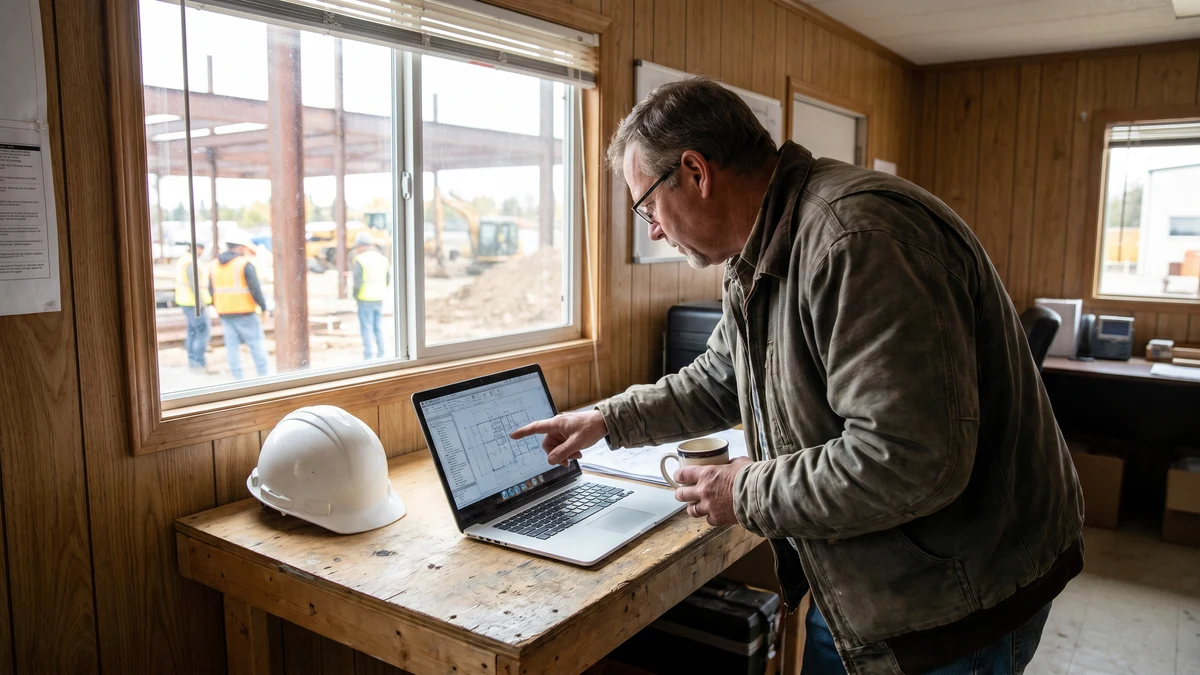
Here's a scenario that plays out on construction sites every single day: A project manager pulls into the job site trailer, connects to whatever WiFi hotspot is available — sometimes a carrier hotspot, sometimes a shared router that's been running unsecured since the project started — and opens the project management software, checks email, and reviews subcontractor invoices.
That connection? Potentially wide open.
Public and semi-public WiFi networks are prime targets for a technique called a man-in-the-middle (MITM) attack. An attacker positions themselves between your device and the network and silently intercepts everything you send and receive — logins, documents, financial data — without you ever knowing.
A VPN encrypts all traffic leaving your device using AES-256-GCM encryption — the same standard used by the US government for classified data. Even if an attacker intercepts your connection on an unsecured job site network, they get meaningless encrypted data they can't read.
Protect Your Field Teams Today
CyberFence encrypts every connection your crew makes — on job sites, in the field, and working from home. US-operated, zero logs, built for business.
See Plans & Pricing →What a VPN Actually Protects in Construction
Let's be specific about where a VPN adds real protection for construction operations:
Remote Access to Project Management Systems
Tools like Procore, Autodesk Construction Cloud, and Buildertrend contain sensitive project data, subcontractor agreements, and client information. When field staff access these platforms over unsecured connections, that login session can be intercepted. A VPN creates an encrypted tunnel so credentials and session data stay private.
Email and Financial Communications
Construction invoice fraud — where attackers intercept email threads and swap in fraudulent bank account numbers — is one of the fastest-growing scams in the industry. While a VPN doesn't stop phishing emails, it prevents attackers from intercepting your outgoing email traffic on unsecured networks. Combined with email authentication protocols, it significantly raises the barrier for interception-based fraud.
CAD Files and Blueprint Access
Architects and engineers accessing large drawing files remotely benefit from encrypted transfers. Whether it's an RFI, submittal, or full construction document set, a VPN ensures that sensitive IP doesn't travel unencrypted across the internet.
Subcontractor Portal Access
If you run a subcontractor portal or shared document system, a VPN ensures that every login — whether from your main office, a trailer on a remote site, or a subcontractor's home office — comes through an encrypted connection.
VPN for Multi-Site Construction Operations
Large GCs and specialty contractors often run simultaneous projects across multiple states or regions. Coordinating teams across job sites creates real network security challenges:
- Field superintendents travel between sites and work from hotels and airports
- Estimators pull project data from anywhere they have cell service
- Project engineers share files with architects, owners, and inspectors across open internet connections
- Safety managers upload documentation, photos, and incident reports from mobile devices on site
A VPN built for teams — with centralized management and coverage for every device — lets you enforce consistent security across all of these scenarios. Every employee, every site, every connection gets the same protection as your main office.
Ransomware: The Biggest Threat Construction Hasn't Taken Seriously
The Akira ransomware group — one of the most active in 2024 and 2025 — has explicitly targeted construction and engineering firms. Their typical playbook: breach through a remote access vulnerability or phishing attack, move laterally across the network, encrypt project files, and demand payment before a project deadline.
For a construction company running on thin margins with liquidated damages clauses in every contract, this is catastrophic. A two-week ransomware recovery on a project with $5,000/day delay penalties costs you $70,000 before you've paid a cent in ransom.
A VPN addresses the remote access vector — one of the primary ways ransomware groups get initial access. By encrypting all remote connections and masking your network endpoints, you make it significantly harder for attackers to identify and target exposed systems.
CyberFence for Construction Teams
CyberFence is a US-operated VPN and cybersecurity platform built for businesses that handle sensitive data. For construction companies, it offers:
- AES-256-GCM encryption on every connection — job sites, home offices, hotels, anywhere
- Web Shield DNS filtering that blocks malicious domains before a connection is ever made — stopping ransomware delivery at the network level
- Zero-log policy — CyberFence never records what sites you visit or files you access
- Team management — add and remove field staff, manage devices centrally, and ensure every connection in your organization is protected
- US-operated infrastructure — not just US servers, but a US-based company with US-based operations and support
- NIST and CMMC alignment — if you work on federal or defense construction projects, CyberFence supports the security framework requirements those contracts demand
Construction teams working on government projects — military installations, federal buildings, GSA contracts — face additional compliance requirements under CMMC (Cybersecurity Maturity Model Certification). A VPN is a foundational control in nearly every CMMC practice area related to access control and data protection.
Getting Your Crew Protected: What to Look For
Not all VPNs are built for business use. When evaluating a VPN for your construction company, look for:
- Team/business plans — individual VPNs don't give you centralized control over your crew's connections
- Mobile-first design — most of your field workers are on phones and tablets, not desktops
- Kill switch — automatically cuts internet access if the VPN drops, preventing unencrypted data from leaking
- DNS filtering — blocks malicious sites at the network level, not just after a file is downloaded
- Zero logs — your activity data shouldn't be stored anywhere it can be subpoenaed or breached
- US-based operations — foreign VPN providers are subject to foreign laws and may not offer the same protections
Built for Construction Teams
From the trailer to the boardroom, CyberFence keeps every connection in your organization encrypted and secure. Start your free trial through the App Store or Google Play.
View Team Plans →The Bottom Line
Construction companies carry more cybersecurity risk than most people realize — and less protection than they need. Ransomware groups are actively targeting the industry. Field workers connect to unsecured networks dozens of times a week. Subcontractor chains create attack surfaces that are nearly impossible to fully control.
A VPN won't stop every attack. But it closes the remote access and network interception vulnerabilities that are responsible for a significant share of construction breaches. For an industry where one bad breach can wipe out an entire project's margin — or worse, expose client data and trigger a lawsuit — that protection is worth far more than what it costs.
If your crew is out in the field, they need encrypted connections. It's that simple.