Also on CyberFence: CyberFence's industry directory for other professions · CyberFence for Teams for business VPN with BAA and SSO .
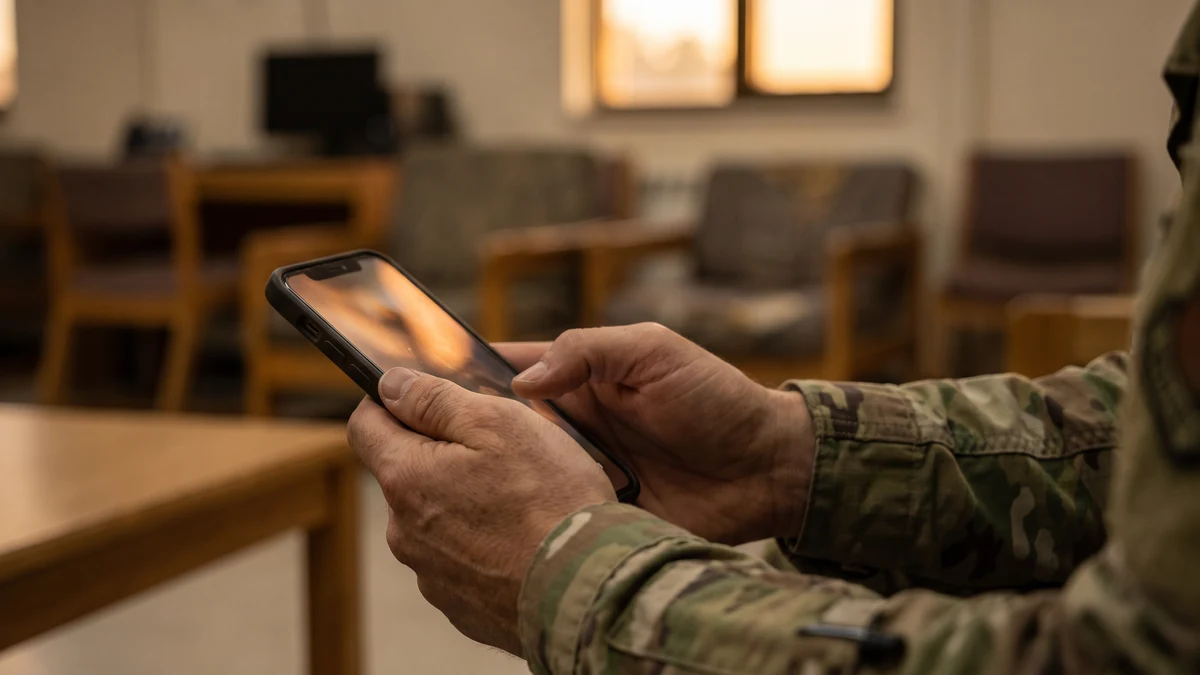
One thing first, before anything else in this article: nothing here applies to a government-issued device or a government network. No VPN — CyberFence or any other — belongs on military IT systems without your command's explicit authorization. Every branch has its own OPSEC guidance and acceptable-use policy, and those policies always come first. This article is about the personal phone, personal laptop, and personal accounts that service members use on their own time — for calling home, banking, and staying in touch with family during a deployment.
With that said, personal digital security for deployed and stationed-overseas personnel is a real and under-addressed problem. Military families are actively and specifically targeted by phishing and romance-scam operations. Base and MWR Wi-Fi has a documented history of weak security. And something as simple as checking your bank account from overseas can trigger a fraud lockout at the worst possible time. Here's what's actually going on and how a US-operated VPN helps on the personal side of that equation.
Military families are a specifically targeted group
Security researchers have documented long-running, organized phishing campaigns that specifically impersonate military support organizations and personnel to target military families and people pursuing online relationships with service members. These aren't generic spam — the scammers research deployment schedules, unit names, and family details to make the approach convincing, then push toward requests for money, gift cards, or personal financial information under the guise of "emergency leave fees," "shipping costs for personal items," or "verification" for a support organization that doesn't actually exist.
The Army's own Criminal Investigation Division runs a dedicated tip line for exactly this reason, and its social media safety guidance specifically warns families to verify unusual requests through official channels rather than the messaging platform where the request arrived.
None of that is something a VPN fixes directly — it's a behavioral and awareness problem. But the DNS-layer piece of the puzzle matters here too: many of these scams eventually route through a phishing link (a fake "official" portal, a fake support-organization donation page, a fake military pay/benefits site). A VPN with real-time DNS-level phishing blocking stops those links from resolving in the first place, for both the service member and the family members back home who install the same app.
One layer of protection for the whole family
CyberFence covers phones, laptops, and tablets on one subscription — deployed service member and family back home. US-operated, AES-256-GCM encryption, Web Shield DNS-level phishing and malware blocking, Breach Monitor for every email address on the account.
Start Your Free TrialBase Wi-Fi and MWR networks have a real security track record
Base housing and MWR (Morale, Welfare and Recreation) Wi-Fi networks are shared infrastructure, and independent security reviews and internal Air Force assessments have both documented the same pattern over the years: large numbers of unsecured or weakly secured wireless networks on base, with real potential for a nearby device to access another resident's traffic or hard drive contents on a misconfigured network. One published penetration test at multiple facility locations found the majority of networks tested could be breached in under two hours, largely due to weak passwords and default configurations that were never changed.
This is exactly the kind of network — shared, unmanaged, sometimes using consumer-grade equipment maintained on an inconsistent patch schedule — where encrypting your own personal device's traffic matters most. A VPN on a personal phone or laptop connected to base or MWR Wi-Fi means that even if the network itself has a weak link somewhere, your traffic is encrypted end-to-end and unreadable to anyone else on that same network.
Geo-blocking and fraud flags while overseas
Two mundane but genuinely disruptive problems come up constantly for anyone stationed or deployed outside the US:
- Bank and credit card fraud flags. US banks watch for logins from unexpected countries and will often freeze an account or block a card the moment it detects a login from an overseas IP address — precisely the wrong moment for that to happen. Connecting through a VPN server located in the US, ideally near your home state, presents the bank with a login pattern that looks like your normal one and avoids tripping that fraud flag in the first place. (If your bank still challenges the login, complete the MFA verification honestly — don't turn the VPN off, since that just teaches the bank's fraud model that unencrypted access is your new normal.)
- Geo-restricted content and services. Streaming libraries, some news sites, and certain US-only services restrict access based on IP location. A US VPN server resolves this the same way it does for any traveler abroad — you get the US catalog and access you already pay for.
What actually matters when picking a VPN for this situation
Given everything above, here's what to look for:
US-operated, not just "US servers"
Some VPN brands market "servers in the US" while the company itself is incorporated and operated offshore, outside US jurisdiction and disclosure law. For a US service member, a US-operated provider — meaning the company, its logs, and its legal accountability are under US law — is the more sensible choice. CyberFence is US-operated out of Orlando, Florida.
A kill switch, always on
If the VPN connection drops for any reason on an unfamiliar or shared network, a kill switch stops all traffic instantly rather than silently falling back to an unencrypted connection. This matters more on base and MWR Wi-Fi than almost anywhere else, given the documented weaknesses in that infrastructure.
Real DNS-level phishing and malware blocking
Given how specifically military families are targeted by phishing operations, DNS-level blocking (not just a browser extension) is the feature that actually intercepts a meaningful share of those attacks before a family member or service member can click through and hand over information. CyberFence's Web Shield runs at the DNS layer across every browser and app on the device.
Coverage for the whole family, on one account
Deployment security isn't just about the service member's own device — it's about protecting the accounts and devices of the people back home who are the actual target of most of these scams. A single subscription that covers phones, laptops, and tablets for the whole household is simpler to manage and cheaper than separate subscriptions.
Breach monitoring on every email address in the family
If a family member's email shows up in a data breach while a service member is deployed and harder to reach, an alert that names the specific breached service lets whoever's home rotate that password immediately, rather than discovering it months later.
Always check with your command first
Policies on personal VPN use vary by branch, by installation, and sometimes by specific unit, and they do change. Some OPSEC guidance is more restrictive in certain deployed environments than others. Before installing anything, confirm with your command what's authorized for personal devices on personal networks — this isn't a formality, it's the first and most important step, and it takes priority over every recommendation in this article.
Protect your family's accounts while you're overseas
CyberFence: US-operated, AES-256-GCM VPN, Web Shield DNS-level phishing and malware blocking, Breach Monitor for the whole family. One subscription for every device in the household. Free Trial included.
See Pricing and Start Free TrialBottom line
Military families are a specifically and repeatedly targeted group for phishing and romance-scam campaigns, base and MWR Wi-Fi has a documented history of weak security, and something as ordinary as checking a bank account from overseas can trigger a fraud lockout at the worst time. None of this touches government devices or networks — that's your command's domain, always. On the personal side, a US-operated VPN with a real kill switch, DNS-level phishing blocking, and coverage for every device in the household closes real gaps for less than the cost of one MWR pizza night a month. Check with your command first, then protect the personal accounts that are actually in the crosshairs.
Want to go deeper? Read how CyberFence protects other regulated industries , the CyberFence Teams product page , or CyberFence plans and pricing .