Also on CyberFence: CyberFence's industry directory for other professions · CyberFence for Teams for business VPN with BAA and SSO .
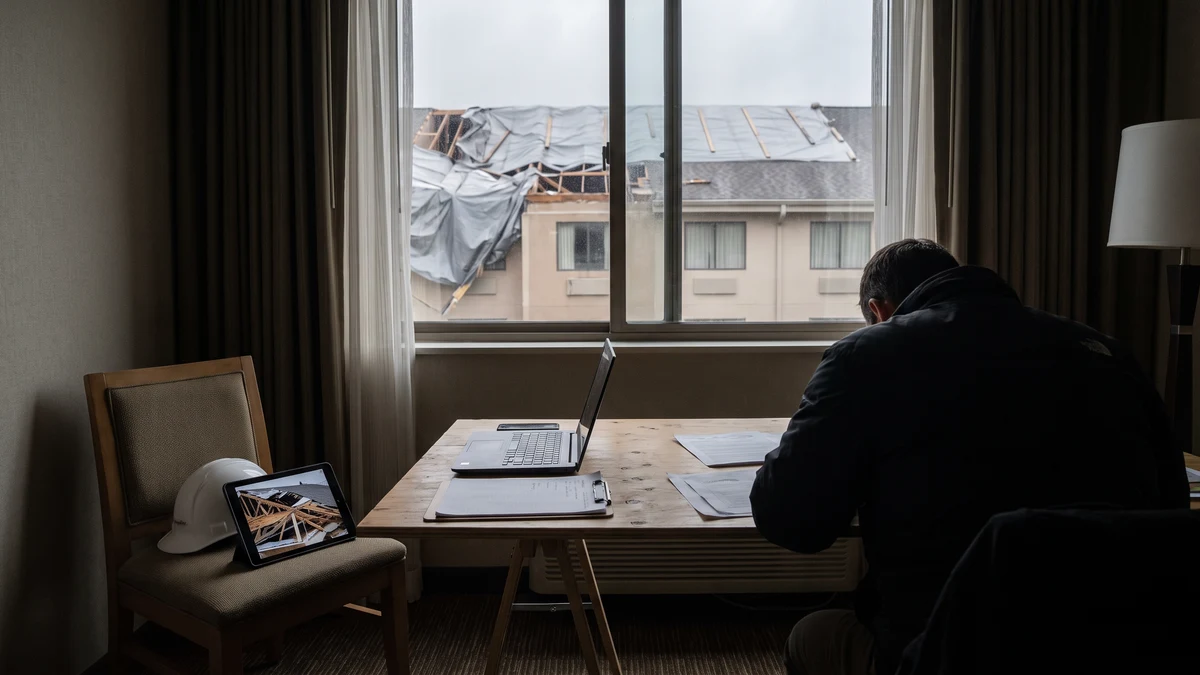
When a hurricane, wildfire, or major storm hits, independent and catastrophe ("CAT") adjusters get a deployment notice and are on the road within 24 to 48 hours. For the next several weeks, the job happens almost entirely out of a hotel room, a rental car, or a temporary command post near the disaster zone — writing up claims, uploading damage photos, and handling claimant financial and medical information over whatever network is available.
That deployment model is efficient for getting claims processed fast after a disaster. It's also one of the more exposed working setups in any licensed profession, because the network you're connecting to is rarely one you control, and the data on your laptop is exactly the kind of information state privacy laws and insurer contracts expect you to protect.
What's Actually on an Adjuster's Laptop
A single active claim file can include a claimant's name, address, Social Security number, bank account details for the settlement payment, medical records for injury claims, photos of the interior of their home, and policy and coverage details. Multiply that by the dozens of claims a CAT adjuster carries during a deployment, and a compromised laptop or an intercepted connection isn't a minor incident — it's potential exposure for every person on that claim list.
Most states require adjusters to hold a license, and many carriers and independent adjusting (IA) firms contractually require reasonable safeguards for claimant data as a condition of doing the work. A data exposure during a deployment can mean more than an uncomfortable conversation with a claimant — it can jeopardize the adjuster's standing with the firms that assign the work.
Where the Exposure Actually Happens
Hotel Wi-Fi as the Default Office
During a CAT deployment, the hotel room is the office for weeks at a time. Hotel networks are a well-documented target for man-in-the-middle attacks and are shared by dozens of other guests on the same network — not the kind of connection you'd choose for uploading a claimant's bank details if you had another option.
Mobile Hotspots in Disaster Zones
Storm-damaged areas often have degraded cellular infrastructure, pushing adjusters onto whatever open Wi-Fi is nearby — a gas station, a fast food restaurant, or a community shelter's public network — just to file a report before end of day. Those networks are convenient and completely unsecured.
Shared Command Posts
Large-scale catastrophe response sometimes means working from a shared claims office or command tent with a single shared network serving dozens of adjusters and support staff from different firms. A shared network is still an unsecured one from a data-in-transit standpoint, regardless of how official the setup looks.
Every deployment network should be treated as untrusted. CyberFence gives you AES-256-GCM encryption on every device, so claimant data stays protected whether you're on hotel Wi-Fi or a shelter's public hotspot.
See CyberFence Plans →Firm Assignments Depend on Trust
Independent adjusters build their income around being assigned work by IA firms and carriers, often repeatedly over multiple deployments and storm seasons. That assignment relationship depends on the firm trusting that the adjuster handles claimant data responsibly in the field — not just filling out forms correctly, but not putting the firm's data-handling obligations at risk while working from unpredictable locations. An adjuster who causes a data exposure during a deployment, even an unintentional one, is a liability the firm has to account for the next time deployment rosters go out.
Some IA firms and carriers are starting to ask directly during onboarding or contract renewal how adjusters secure their connection while working remotely. Having a straightforward answer — an encrypted VPN running on every device used for claim work — is a credible, low-friction response. Not having one is a harder position to be in when a firm is deciding who gets the next deployment.
The Cost of Getting It Wrong
IBM's 2026 Cost of a Data Breach Report puts the average breach cost in the United States at roughly $11.5 million, nearly double the global average, driven in large part by AI-accelerated attacks and higher regulatory and legal costs. Financial services breaches specifically averaged around $6.3 million. Insurance carriers and IA firms are underwriting that risk across every adjuster in the field, which is exactly why more firms are starting to specify basic technical safeguards — encrypted connections, updated devices, secure file transfer — in their independent contractor agreements.
For an individual adjuster, the calculation is simpler: a laptop or phone compromised during a deployment doesn't just put one claim at risk — it can put every open claim on that device at risk, along with the working relationship with the firm that assigned the work.
What to Look for in a VPN for Deployment Work
- AES-256-GCM encryption — encrypts claim files, photos, and settlement details in transit on every network, so an intercepted hotel or public connection doesn't hand over readable claimant data.
- A kill switch — automatically cuts your connection if the VPN drops, which matters when you're jumping between cellular and hotel Wi-Fi throughout the day during a deployment.
- A verified zero-log policy — claimant financial and medical information deserves a provider that isn't keeping records of your connections either.
- US-operated infrastructure — keeps your traffic off servers subject to foreign data-retention rules, consistent with the same privacy expectations covering the claim files themselves.
- Coverage across every device — laptop, phone, and tablet under one subscription, since deployment work moves across all three depending on where you're standing.
Deployments don't pause for a secure network. CyberFence protects every device you use in the field — laptop, phone, and tablet — with AES-256-GCM encryption, a Kill Switch, and a strict zero-log policy. Starting at $7.99/mo.
Protect Your Claim Files →The Bottom Line
Catastrophe and field adjusting is built around speed — get to the disaster zone, process claims, move to the next site. A VPN with strong encryption and a verified no-logs policy doesn't slow that down. It's a small, inexpensive addition to a kit that already includes a laptop, a hard hat, and a rental car, and it closes one of the most overlooked gaps in how sensitive claimant data actually moves during a deployment.
Want to go deeper? Read how CyberFence protects other regulated industries , the CyberFence Teams product page , or CyberFence plans and pricing .