Also on CyberFence: CyberFence's industry directory for other professions · CyberFence for Teams for business VPN with BAA and SSO .
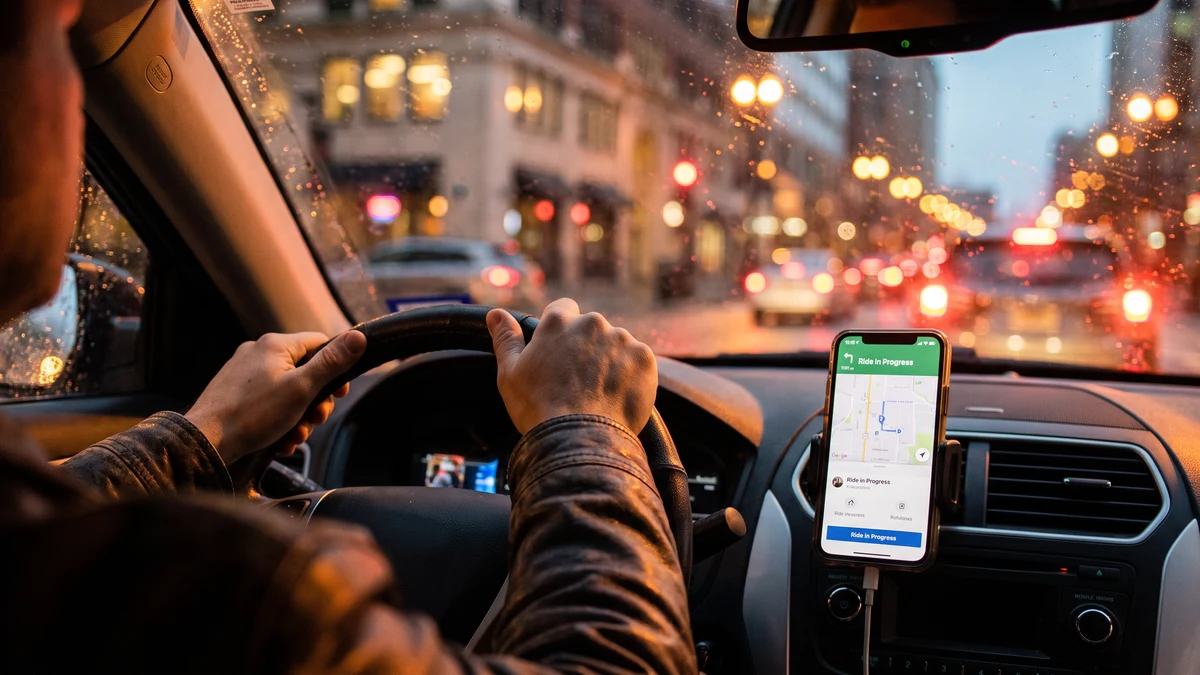
If you drive for Uber, Lyft, DoorDash, Instacart, or any other gig platform, your phone is your entire business. It holds your banking app, your ride-hailing account, your earnings history, and constant public Wi-Fi connections at gas stations, parking lots, and delivery pickup zones. That makes it one of the most attractive targets in cybercrime right now — and the attacks aren't hypothetical.
Drivers Are Being Targeted Right Now
In mid-2026, Australia's Transport Workers Union reported a sharp rise in a phishing scam hitting delivery drivers on DoorDash and Uber: a scammer poses as a customer, places an order, then calls the driver claiming the order was "cancelled due to suspected fraud." The driver is talked into handing over account details to get "compensated" — and the scammer uses those details to break into the driver's account. The union has already helped recover more than $50,000 in stolen driver earnings from this single scam pattern.
The same playbook has been running in the US for years. Shipt and Target personal shoppers have reported scammers spoofing corporate phone numbers, triggering a password-reset email, then calling to "verify" the reset code — walking straight past two-factor authentication in the process. TransUnion's 2026 Gig Economy Worker Report found that over a third of gig workers have been targeted by fraud while working a platform, and researchers at Harvard Law's Cyberlaw Clinic have pointed out a hard truth: gig platforms often don't give contractors the same security training or account protections that full-time employees get. You're expected to defend your own account.
Why Your Setup Is a Bigger Target Than You'd Think
A few things make rideshare and delivery drivers unusually exposed:
- You're constantly on public networks. Free Wi-Fi at gas stations, coffee shops, and restaurant pickup counters is convenient between rides — and it's also one of the easiest places for someone nearby to intercept unencrypted traffic on the same network.
- Your phone is your paycheck. Banking apps, instant-payout tools, and your driver account all live on one device. If that device or account is compromised, your income is compromised with it.
- Deactivation threats work because they're real. Ride-hailing platforms really do deactivate accounts over fraud flags, which is exactly why "your account will be deactivated unless you verify now" messages are so effective on drivers — the threat is genuinely plausible.
- "Tap and snatch" theft is a physical extension of the same problem. Law enforcement in several major cities has tracked robberies where a fake passenger asks to "enter an address" on the driver's phone, then uses that access to drain rideshare and payment accounts on the spot.
What a VPN Actually Does Here
A VPN is not a fraud-proof shield, and no one should tell you it is. But paired with basic account hygiene, it closes off several of the exact weaknesses these scams rely on:
- Encrypts your connection on public Wi-Fi. CyberFence uses AES-256-GCM encryption on every connection, so traffic on a gas-station or restaurant network can't be casually intercepted by someone else on that same network.
- Blocks known phishing domains before you land on them. CyberFence's Web Shield filters DNS requests at the network level, blocking known phishing and malware domains — including many of the fake "reset your password" pages scammers text or call about.
- Watches for your info showing up in breaches. CyberFence's Breach Monitor checks whether your email or phone number has turned up in a known data breach, so you're not caught off guard if a platform you drive for gets hit.
- Zero logs, US-operated. CyberFence doesn't sell or share your driving patterns or location history, and as a US-based company, it isn't quietly obligated to a foreign government's data-sharing rules the way some "budget" VPN providers are.
The Habits That Actually Stop These Scams
Since these attacks are built around trust and urgency, not just technical exploits, a few habits matter as much as the software:
- Never take an account or password "verification" call. Real platforms don't call to read back a reset code or ask you to confirm your password over the phone. Hang up and check the app directly.
- Ignore in-app requests to "enter an address" on your own device from a passenger. Have them show you the address, or enter it yourself without unlocking further into your phone.
- Turn on two-factor authentication anyway. It doesn't stop every attack (some scams intercept the code too), but it stops the casual ones — the majority.
- Use a VPN and DNS-level filtering every time you're on the road, not just at home. That's when you're most exposed to both public Wi-Fi risk and well-timed phishing texts.
Protect the phone your income depends on
CyberFence gives rideshare and delivery drivers AES-256-GCM encryption, DNS-level phishing protection, and breach monitoring — all in one app, covering every device on your plan.
Start Your Free TrialBottom Line
Gig platforms move fast and don't always protect the people driving for them. The phishing scams hitting rideshare and delivery drivers right now are built to sound exactly like the real deactivation and fraud alerts these platforms already send — which is what makes them work. A VPN with real phishing-domain blocking, strong encryption on public Wi-Fi, and breach monitoring won't stop every trick, but it closes off the technical paths scammers rely on and gives you a real safety net while you're on the road.
Drive with a lot less risk
Get CyberFence for $7.99/mo, or save 8% at $88.21/yr ($7.35/mo).
Get Protected TodayWant to go deeper? Read how CyberFence protects other regulated industries , the CyberFence Teams product page , or CyberFence plans and pricing .