Also on CyberFence: CyberFence's industry directory for other professions · CyberFence for Teams for business VPN with BAA and SSO .
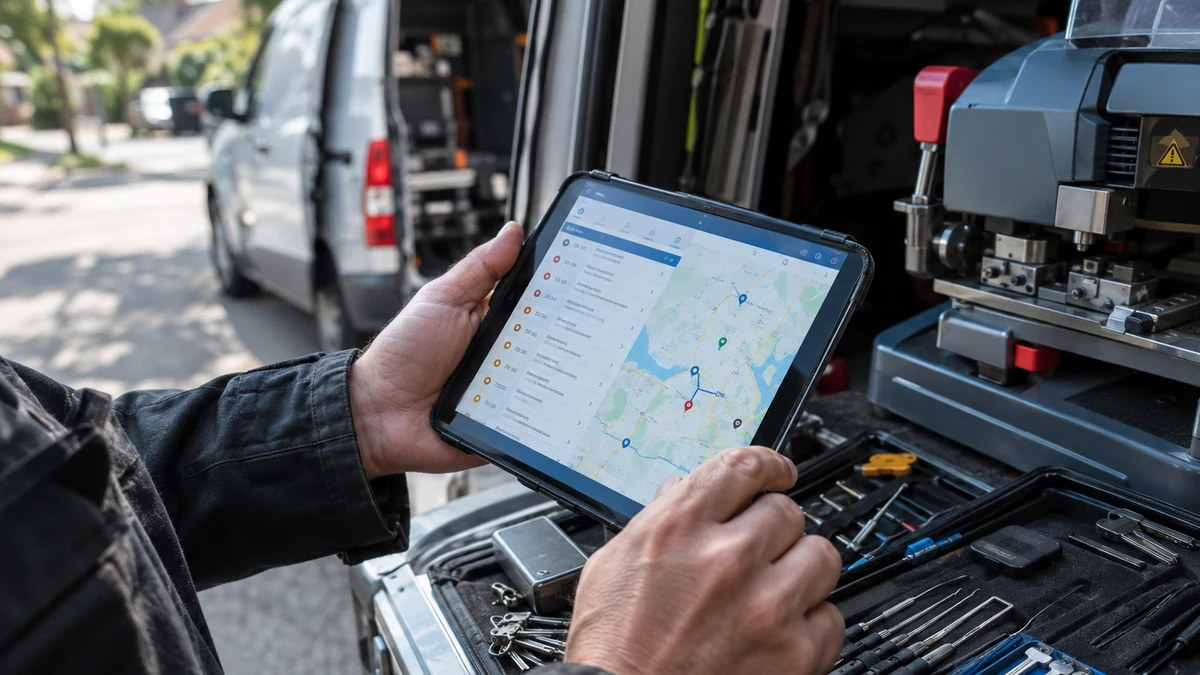
A locksmith's phone or tablet carries something most trades don't: a running list of exactly which addresses have which locks, alarm codes, and security weaknesses. That information moves between calls over whatever network is available — cellular data at the curb, a client's home Wi-Fi, or a hotspot from the van — and it's exactly the kind of data that shouldn't end up in the wrong hands.
Most locksmiths think about physical security all day and rarely think about the security of the device they're using to run the business. That gap is worth closing.
What's Actually on a Locksmith's Devices
A modern locksmith operation runs on a dispatch and scheduling app, a customer database, and often a payment processor, all accessed from a phone or tablet in the field. That system typically holds customer names and addresses, notes on lock brands and vulnerabilities, gate and alarm codes clients have shared for access, service history, and payment details. Field service management research on the trade puts it plainly: paper systems and unencrypted spreadsheets create real vulnerabilities, and a single stolen laptop or lost clipboard full of customer information can result in liability claims and lasting reputational damage.
Unlike a lot of client data, this isn't just personal information — it's a literal map of which homes and businesses have which security setups. A locksmith's database is a more attractive target for the wrong person than almost any other small trade carries around.
Why Licensing Already Treats This Seriously
Most states that regulate locksmiths require a criminal background check before issuing a license — California's Bureau of Security and Investigative Services, for example, requires every locksmith company owner, partner, or officer to pass an FBI and state DOJ background check before they're allowed to touch a client's locks. That level of scrutiny exists because the trade is fundamentally about trust with access and security information. The same logic that justifies a background check for the person applies to the device holding the client list — an unprotected phone can expose exactly the kind of information the licensing process was designed to keep safe.
Where the Exposure Actually Happens
Client Wi-Fi at the Job Site
Uploading photos of a completed job, logging a new alarm code, or processing a payment while connected to a client's home or office Wi-Fi puts that data on a network you don't control and can't verify.
Public Hotspots Between Calls
Waiting on the next dispatch at a coffee shop or gas station often means jumping on public Wi-Fi to save mobile data — the same networks that are a well-documented target for interception.
Shared Devices and Subcontractors
Locksmith businesses that use subcontracted or on-call technicians often share dispatch app access across multiple devices and personal phones, multiplying the number of unsecured endpoints that can see the full client and access-code database.
After-Hours and Emergency Calls
Lockout and break-in emergency calls tend to happen late at night, in unfamiliar neighborhoods, often with a distressed client standing right there wanting the job done fast. That's exactly the environment where a technician is least likely to think twice about which network their phone just connected to, and most likely to skip a step to get the customer back inside quickly.
Client access codes deserve the same protection as the locks themselves. CyberFence encrypts every connection your dispatch app and payment processor use with AES-256-GCM encryption, on every device your business runs on.
See CyberFence Plans →Smart Locks Raised the Stakes
The trade has shifted well past cutting keys. Smart lock installation now means a locksmith often walks away holding a client's Wi-Fi network name and password, the admin credentials for a connected lock app, and sometimes remote-access permissions to unlock a door from anywhere. That's a meaningfully bigger liability than a physical key ever was — a compromised phone doesn't just expose an address anymore, it can expose live remote access to a client's front door. Cyber insurers serving the security trades have started treating this shift seriously, pointing out that locksmiths now carry the same kind of digital exposure as any business handling scheduling, customer databases, and payment processing online, on top of the physical-security liability the trade has always carried.
The Cost of a Leak in This Trade
Small businesses are now the primary target for cyberattacks, not an afterthought — 43% of all cyberattacks are aimed at small and medium-sized businesses, and 40% of SMB owners say a cyberattack costing $100,000 or less could put them out of business entirely. For a locksmith, the calculation is sharper still: a leaked client list with addresses and access codes isn't just a data breach, it's a physical security failure for every customer on that list, and the kind of story that ends a local reputation built over years in one news cycle.
What to Look for in a VPN for This Work
- AES-256-GCM encryption — protects client addresses, access codes, and payment details in transit on every network, so an intercepted connection at a job site or coffee shop doesn't expose readable data.
- A verified zero-log policy — the business built on being trusted with keys and codes deserves a provider that isn't keeping its own record of your connections.
- A kill switch — automatically cuts the connection if the VPN drops, so a dropped signal between the van and a job site doesn't leave data exposed mid-transfer.
- Coverage across every device — phone, tablet, and any subcontractor devices running the dispatch app, under one subscription.
- US-operated infrastructure — keeps client data off servers subject to foreign data-retention rules.
Protect the list, not just the locks. CyberFence secures every device your business runs on with a Kill Switch, zero-log policy, and AES-256-GCM encryption. Starting at $7.99/mo.
Get Protected →The Bottom Line
Locksmiths are already trusted with the physical security of homes and businesses across their entire client base — licensing boards make sure of that before handing out a badge. The device holding that same client list deserves the same level of care. A VPN with strong encryption and a verified no-logs policy is a small addition to a toolkit that already includes picks, cutters, and a spotless background check, and it closes one of the easiest ways that trust could be broken by accident.
Want to go deeper? Read how CyberFence protects other regulated industries , the CyberFence Teams product page , or CyberFence plans and pricing .